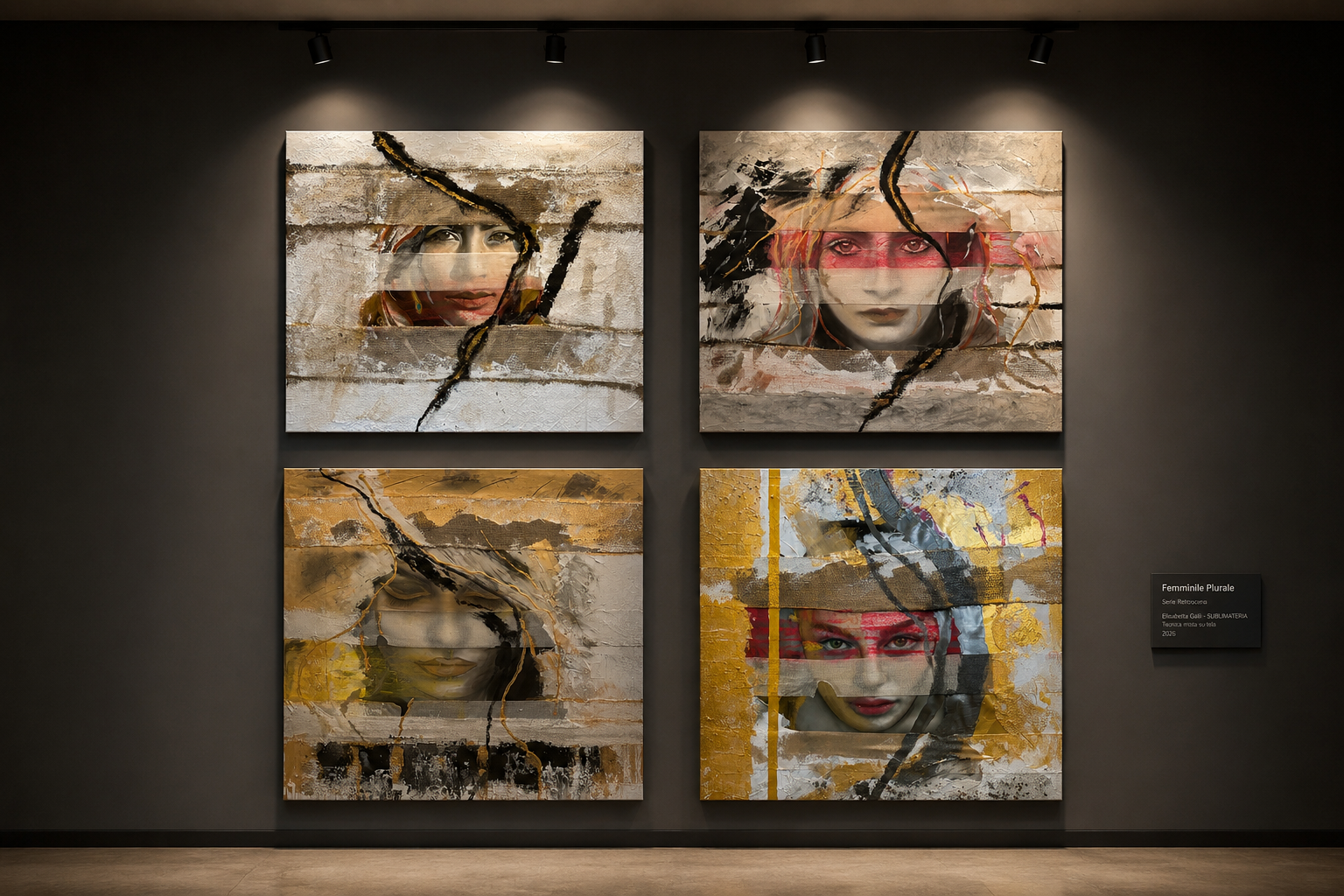
If you have ever stood in front of a work of art and found yourself wanting to reach out and touch it, wondering what it was made from and how on earth it was made, there is a strong chance you were looking at mixed media art. It is one of the most tactile, layered and intellectually rich forms of contemporary artistic expression, and it is also one of the most misunderstood.
At Sublimateria, mixed media is not simply a technique we use. It is the foundation of everything we create. In this beginner’s guide, we explain what mixed media art is, how it works, what materials it involves and why it has become one of the defining forms of contemporary abstract art Italy and beyond.
What Is Mixed Media Art, Simply Explained
Mixed media art is any artwork made using more than one material or medium within a single piece. Rather than working exclusively with oil paint, watercolour or charcoal, a mixed media artist combines multiple materials to create a work that is richer, more complex and more layered than any single medium could achieve alone.
The term itself is broad by design. A work could combine paint with collaged paper. It could layer photography with hand-drawn marks. It could build up a canvas surface with structural paste, fabric, found objects and gold leaf until the boundary between painting and sculpture becomes genuinely unclear. That ambiguity is not a limitation. It is the point.
What makes mixed media particularly compelling is that it privileges process over convention. There is no prescribed way to make a mixed media work. The artist makes decisions at every stage about which materials to introduce, in what order and to what end. The result is an object that carries the evidence of that decision-making in its surface, its texture and its depth.
A Brief History of Mixed Media Art
Mixed media as a formal practice began in the early twentieth century, though artists have been combining materials for as long as art has existed. The moment most art historians point to is 1912, when Pablo Picasso created his collage Still Life with Chair Caning, incorporating rope, oil cloth and paint in a single work. This was the first time a major artist deliberately mixed materials with the intention of questioning what a painting was and what it could be.
From that point, the possibilities expanded rapidly:
- Cubism (1910s) introduced collage and fragmented perspective into fine art
- Dada (1916–1924) embraced found objects and anti-art logic, combining anything and everything
- Assemblage art (1950s–1960s) created three-dimensional works from everyday objects and discarded materials
- Pop Art (1960s) brought commercial imagery and mass-produced materials into gallery spaces
- Contemporary mixed media (1980s–present) encompasses digital integration, recycled materials, organic substances and handmade processes in endlessly varied combinations
Today, mixed media painting sculpture is one of the most widely practised and collected forms in the contemporary art world. It sits comfortably in major institutions and private collections alike, and it continues to evolve as artists find new materials, new processes and new questions to ask through the work.
What Materials Are Used in Mixed Media Art
One of the most common questions people ask when they encounter mixed media for the first time is simply what it is made from. The honest answer is that it can be made from almost anything. However, certain materials appear consistently across the practice because of their particular visual, tactile and structural properties.
Material Common Examples Effect on the Work Category
Structural Canvas, wood panel, Determines the weight and foundations cardboard, paper scale of the piece
Wet media Acrylic paint, oil paint, Adds colour, depth and ink, resin transparency
Dry media Graphite, charcoal, Creates mark-making texture chalk, pastel and line
Applied textures Gesso, structural paste, Builds three-dimensional modelling compound surface relief
Found and recycled Cardboard, packaging, Adds narrative, texture and materials fabric, newspaper conceptual meaning
Natural materials Volcanic lapilli, sand, Brings organic depth and earth pigments, fibres material authenticity
Precious materials Gold leaf, silver leaf, Creates luminosity and copper leaf surface tension
Metal elements Copper mesh, wire, Adds structural and visual hardware complexity
At Sublimateria, we work with recycled cardboard, volcanic lapilli, gold-leaf finishes, copper mesh, structural paste and gesso, together with paint and drawing media such as acrylic, soft and oil pastel, charcoal, resin and wax, as our primary material language. You can read more about our specific process and the role each material plays in the way we build each work.
The Difference Between Mixed Media and Multimedia Art
This is a distinction worth understanding clearly because the two terms are often used interchangeably but they refer to quite different things.
Mixed media art refers to a visual artwork that combines more than one physical material or medium within a single piece. Everything happens on or within the physical object itself. Paint, paper, texture, found objects, gold leaf, it is all present in the finished work as tangible, material substance.
Multimedia art, by contrast, incorporates electronic or non-visual elements alongside the visual. A multimedia work might combine video projection with painting, or recorded sound with sculpture, or interactive digital elements with physical installation. The defining feature of multimedia is the inclusion of technology or performance as a core component of the work.
The practical difference for a collector is that mixed media artworks are physical, displayable objects that function like traditional paintings or sculptures. They live on walls or plinths. Multimedia works often require equipment, power and specific spatial conditions to be experienced. When we talk about what is Sublimateria, we are talking about a practice rooted entirely in mixed media, handmade, material and built to last in a domestic or institutional setting.
Mixed Media Art Techniques Every Beginner Should Know
Understanding the key techniques used in mixed media helps you read and appreciate the work more deeply when you encounter it. Each technique has its own visual logic and its own contribution to the overall effect of a piece.
Collage and Assemblage
Collage involves adhering flat materials such as paper, fabric or photographs to a surface to create a layered composition. Assemblage extends this into three dimensions, incorporating objects with physical depth. Both techniques are foundational to mixed media and were pioneered by the Cubists and Dadaists in the early twentieth century. You can see the influence of collage and assemblage art across our Frammenti series, where fragments of printed material are embedded into the surface of larger works.
Impasto and Texture Building
Impasto is the technique of applying paint or paste in thick, sculptural layers that stand proud of the surface. In mixed media, this is often taken much further than in traditional painting, with structural paste, gesso, sand, volcanic material or organic substances built up into significant relief. The result is a surface that is as much sculptural as it is painted. Our Syntropy series uses this approach extensively, building surfaces that have genuine physical depth.
Layering and Transparency
Layering involves building a work in sequential stages, with each layer either covering or allowing the previous one to show through. Transparent media such as resin, ink washes and diluted acrylic are used to create depth and luminosity, while opaque layers add weight and solidity. The interplay between what is hidden and what is visible gives many mixed media works their particular sense of history and time.
Mark-Making and Drawing
Mixed media works often incorporate direct mark-making with pencil, graphite, charcoal or ink on top of or between other layers. This draws from the tradition of drawing in a way that anchors the work in the human gesture even when the surrounding materials are highly processed or industrial. You can see this clearly in works from our Entanglement series, where graphite lines run through built-up surfaces to create a sense of mapping and connection.
What Makes Handmade Textured Canvas Art Different
Within the broader world of mixed media, handmade textured canvas art occupies a particularly valued position. The texture of a work is not simply a visual quality. It is a physical record of the process that made it.
When you look at a textured surface, you are reading the sequence of decisions the artist made. Where did they press hard? Where did they pull back? Where did they introduce a new material and why? The answers are written into the surface in a way that no reproduction can capture. A photograph of a textured artwork is, in a very real sense, as incomplete as a photograph of a piece of music.
This is why handmade textured canvas art consistently commands greater attention and value than flat printed works. The texture is the evidence of the hand, and the hand is the evidence of the human being who made the work. To see mixed media art examples of this quality, we invite you to browse the full portfolio of works at Sublimateria, where every piece carries exactly this kind of surface complexity.
Mixed Media Art in the Context of Contemporary Abstract Art Italy
Italy has a long and distinguished relationship with material innovation in art, from the gold-ground panel paintings of the medieval period through the Arte Povera movement of the 1960s and 1970s, which used everyday and industrial materials to question the nature and value of art. This tradition continues in the work of contemporary artists who draw on both the richness of Italian visual culture and the possibilities of present-day materials.
Contemporary abstract art Italy is not a single style or movement. It is a conversation between material, place and intention that takes different forms in different hands. At Sublimateria, our work is rooted in this Italian tradition of taking matter seriously. We treat our materials not as decoration but as meaning. The volcanic lapilli we press into surfaces come from the geology of a specific landscape. The recycled cardboard carries the traces of previous use. The gold-leaf finish connects to centuries of Italian gilding tradition. You can learn more about the thematic areas and series that organise our work and how each one explores different aspects of this material philosophy.
If you are curious about who we are and why we make art in this way, we invite you to read about the artist behind Sublimateria and the path that led from a career in psychology and business to a studio practice rooted in transformation and matter.
How to Begin Collecting Mixed Media Art
If this is your first encounter with mixed media as a collector, the most important advice we can offer is to trust your physical response to the work. Abstract mixed media art does not ask you to decode a narrative. It asks you to be present with a surface, with colour, with texture and with the questions the work raises in your own mind.
When you are ready to explore further, contact us directly and we will help you find a work that is right for your space, your sensibility and your budget. We are always happy to share more about the works in our collection, the stories behind individual pieces and what it means to live with an original mixed media artwork over time.
Frequently Asked Questions
1. What Is Mixed Media Art in Simple Terms?
Mixed media art is any artwork made using more than one material or medium within a single piece. Instead of working only in oil paint or only in watercolour, the artist combines multiple materials, which might include paint, paper, fabric, found objects, gold leaf, structural paste or almost anything else, to create a work that is more layered and complex than a single medium could achieve alone. The result is an object that carries the evidence of its process in its surface, its texture and its physical depth.
2. How Is Mixed Media Art Different from Regular Painting?
Traditional painting uses one primary medium applied to a prepared surface, typically oil or acrylic paint on canvas. Mixed media art removes that limitation entirely. A mixed media work might begin with a painted ground but then incorporate collaged materials, built-up texture, drawn marks, gold leaf and embedded objects before it is complete. The surface of a mixed media work is therefore much more complex, physically and conceptually, than a conventional painting, and the process of making it involves a different kind of decision-making at every stage.
3. What Materials Are Most Commonly Used in Mixed Media Art?
The materials used in mixed media art vary enormously depending on the artist and their intentions, but common choices include acrylic or oil paint, structural paste, gesso, recycled paper and cardboard, fabric, found objects, graphite, gold or silver leaf, resin and natural substances such as sand or volcanic material. At Sublimateria, we work with recycled cardboard, volcanic lapilli, gold-leaf finishes, copper mesh and structural paste, together with acrylic, soft and oil pastel, charcoal, resin and wax as our core material language, each chosen because of what it contributes to the meaning and surface quality of the finished work.
4. What Is the Difference Between Mixed Media and Multimedia Art?
Mixed media art refers to a physical artwork that combines more than one tangible material or medium within a single object. Everything that makes the work exists in the physical piece itself. Multimedia art, by contrast, incorporates electronic or non-visual elements such as video, sound, digital projection or interactive technology. A multimedia work typically requires equipment or performance to be experienced. Mixed media works, including everything we create at Sublimateria, are physical objects that live on walls and in spaces without any technological requirement.
5. Who Are Some Famous Mixed Media Artists from Italy?
Italy has a rich tradition of material innovation in art. The Arte Povera movement of the 1960s and 1970s, which included artists such as Michelangelo Pistoletto, Mario Merz and Jannis Kounellis, was particularly significant in establishing the use of everyday and industrial materials as a legitimate fine art language. In the contemporary period, artists working across Italy continue to develop this tradition in highly individual ways. Elisabetta Galli, the artist behind Sublimateria, is among the contemporary Italian artists exploring mixed media through a practice that combines recycled materials, natural substances and handmade process to create works that are both visually distinctive and conceptually grounded.
6. Can Mixed Media Art Work in a Home Setting?
Yes, and in our experience it works exceptionally well. Handmade textured canvas art brings a quality of physical presence and warmth to domestic spaces that flat prints simply cannot replicate. The surface texture of a mixed media work changes throughout the day as the light shifts, meaning the piece is never static. It offers a continuously evolving visual experience that rewards living with it over time. If you are considering a mixed media work for your home, we recommend visiting our collection for home interiors as a starting point.
7. How Do I Know If a Mixed Media Artwork Is Authentic and Original?
An authentic original mixed media artwork should come with a certificate of authenticity signed by the artist, documentation of the materials and process used, and clear provenance that traces the work from studio to collector. At Sublimateria, every piece we create is individually documented and accompanied by full provenance information. We also encourage collectors to ask questions about the work directly, because an artist who knows their practice well will always be able to speak in detail about how a specific piece was made, what materials it contains and what decisions shaped its development.

Leave a Reply