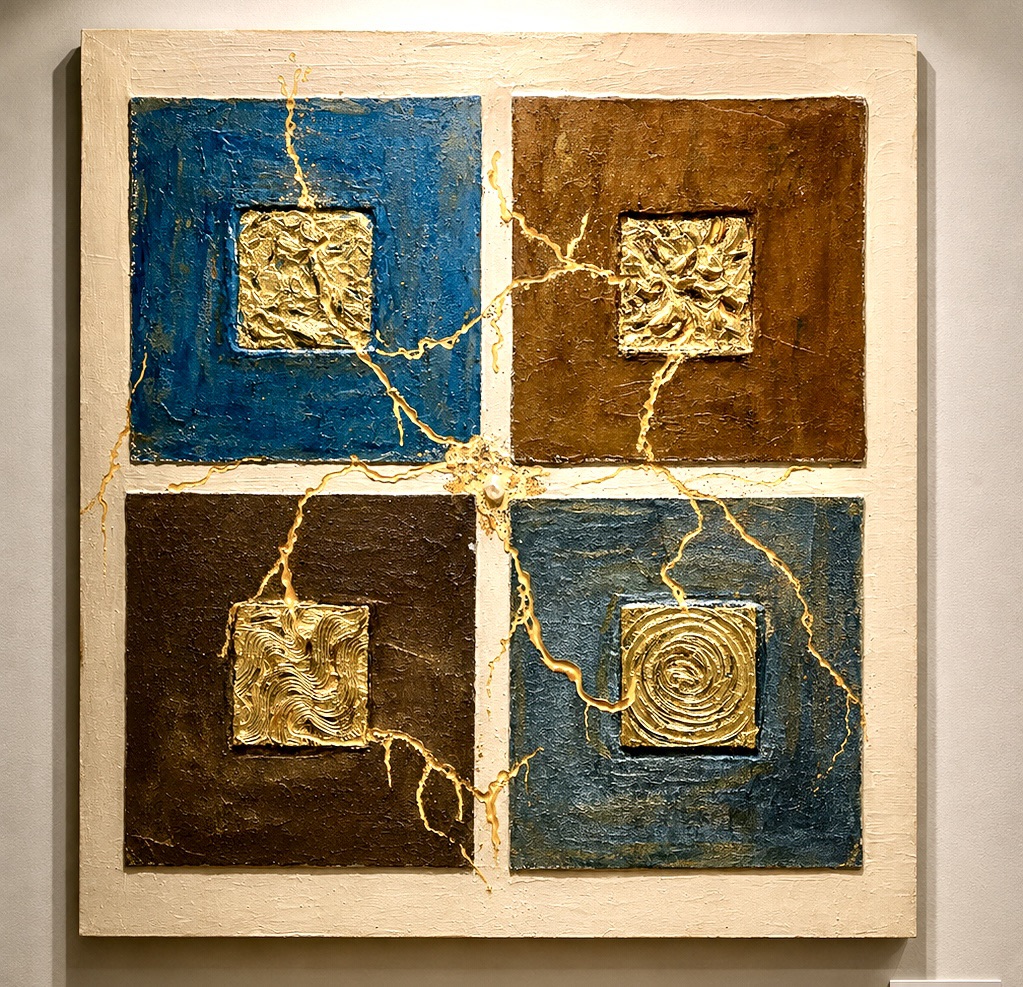
There are materials in the history of art that never quite leave. Gold leaf, in its many forms, is one of them. For more than three thousand years, from the funerary masks of ancient Egypt to the altarpieces of medieval Siena to the gilded surfaces of contemporary mixed media studios, gold leaf has remained one of the most compelling and most demanding materials an artist can choose to work with. And in 2026, its presence in contemporary painting and mixed media work is stronger than it has been in decades.
At Sublimateria, gold leaf is not a decorative afterthought applied to make a work feel precious. It is a material decision with specific intentions, specific effects and a specific relationship to everything else in the work including the handmade texture pastes built up beneath it. In this article we explore the history of gold leaf, the materials used at Sublimateria to achieve its effect, and the technical texture-building process that gives each surface its character.
A Brief History of Gold Leaf in Art
Gold leaf has been used in art for so long that its history is effectively a parallel history of human civilisation itself. Understanding where this material comes from, and what it has meant in different contexts, changes how you see it when you encounter it in a contemporary work.
Period Context How Gold Leaf Was Used
Ancient Egypt (3000 Funerary and Applied to masks, coffins and BCE+) ceremonial art sacred objects to signify immortality
Byzantine Art Religious icons and Gold ground backgrounds to (330–1453 CE) mosaics represent the divine light of heaven
Medieval Europe Altarpieces and Gilded panels and page borders (1000–1400 CE) illuminated signifying sacred value manuscripts
Italian Renaissance Panel paintings and Gold used selectively (1400–1600 CE) frescoes alongside naturalistic painting
Art Nouveau Decorative arts and Gustav Klimt’s iconic use of (1890–1910) painting gold leaf as a primary visual element
Japanese Nihonga Traditional Japanese Gold and silver leaf on silk (ongoing) painting and paper in established artistic tradition
Contemporary Art Mixed media and Gold and imitation gold leaf (1980s–present) installation as material comment on value, light and transformation
The most instructive moment in this history for understanding contemporary use is Gustav Klimt’s work at the turn of the twentieth century. Klimt was the first major Western artist to use gold leaf not as a background or a border but as a primary pictorial element, integrating it into figurative compositions in ways that blurred the boundary between decorative art and fine painting. His approach was controversial at the time and is now regarded as one of the great innovations in the history of the medium. It opened a door that contemporary artists, particularly those working in mixed media painting sculpture, have continued to walk through ever since.
What Gold Leaf Actually Is
Before exploring what gold leaf does in a contemporary artwork, it is worth being precise about what it actually is, because there is significant confusion between genuine gold leaf and other gold-effect materials a distinction we think is worth being transparent about.
Genuine gold leaf is real gold, beaten to an extraordinary thinness, typically around 0.1 microns, which is roughly four hundred times thinner than a sheet of paper. It is available in different carat weights, from 12 carat through to 24 carat, with higher carat leaf being purer, more yellow in tone and considerably more expensive.
Alongside genuine gold leaf, there are several gold-effect materials artists work with:
- Gold paint is a pigment suspension that gives a flat, uniform gold tone without the reflective complexity of leaf
- Metallic powder provides a similar flat effect and is typically mixed with a binding medium before application
- Imitation gold leaf (also called composition leaf or Dutch metal) is made from a copper alloy, giving it a gold appearance without gold’s cost. It shares leaf’s essential optical property it conforms to the texture beneath it and catches light from many planes at once while remaining accessible for regular studio use
At Sublimateria, we work with high-quality imitation gold leaf, chosen deliberately rather than as a compromise. On the heavily textured surfaces we build, it is the leaf’s ability to conform to every ridge and fracture of the surface not the metal’s purity that produces the shifting, light-catching effect the work is known for, and imitation leaf performs that role with real integrity. You can see examples of how it is used across our portfolio of works.
Why Contemporary Artists Still Choose Gold Leaf
The question of why gold leaf in contemporary art remains so significant is worth answering carefully, because the reasons are multiple and not always obvious.
The first reason is purely visual. Gold leaf does something with light that no other material can replicate. Because it is applied in sheets that conform to the texture of whatever surface lies beneath, it reflects light at every point of that texture differently. A flat painted gold surface gives back a single, uniform reflection. A textured surface covered with gold leaf gives back thousands of different reflections simultaneously, shifting as the viewer moves, as the light source changes, as the time of day advances. The result is a material that is genuinely alive in a way that paint, however skilfully applied, cannot be.
The second reason is conceptual. Gold, real or imitation, carries meaning that is impossible to ignore. It is the material associated with value, permanence, the sacred and the royal. When a contemporary artist applies gold-toned leaf to a surface built from recycled cardboard or volcanic stone, they are creating a deliberate tension between the humble and the precious, the discarded and the eternal. That tension is not decorative. It is the argument the work is making.
The third reason is historical. For an artist working in Italy, gold leaf is also a material connection to an extraordinary tradition of craftsmanship that stretches back through the Renaissance and the medieval period to Byzantium. Using it seriously, with skill and intention, is a form of engagement with that history. Italian contemporary art techniques are inseparable from this inheritance, and the best contemporary artists working in Italy today understand that working with gold leaf means entering into a conversation with everyone who has used it before.
Texture Paste: The Technical Foundation Beneath the Gold
The gold surface is only ever as interesting as what lies beneath it. At Sublimateria, the texture that the leaf later reveals is built first, through layered paste work, and this stage is where much of the character of a finished piece is actually decided.
There is no single “texture paste” different mixtures produce very different surfaces, and part of the craft is choosing the right one for the effect a work needs:
- Commercial modelling and structure pastes give consistent, fine-grained texture and are useful where a controlled, repeatable surface is needed
- Heavy body acrylic mediums mixed with sand, marble dust or other aggregates create a coarser, more granular texture with visible tooth
- Handmade paste combining gesso, vinyl (PVA) glue and baking soda produces a lighter, more irregular, almost coral-like texture as the baking soda reacts and expands slightly within the mixture. This is a technique developed and refined in the studio, and it behaves differently from any commercial product: it dries with unpredictable cracks, ridges and pockets that give each surface its own unrepeatable topography
Each of these pastes catches gold leaf differently once applied. A fine commercial paste gives a tighter, more uniform shimmer; the handmade gesso-glue-baking soda mixture, with its irregular peaks and fissures, produces a much more dramatic, uneven play of light and shadow once the leaf is laid over it. Choosing between them or combining several within a single work is one of the primary technical decisions behind every piece.
How Gold Leaf Is Applied to Canvas and Mixed Media Surfaces
The gold leaf painting technique requires specific knowledge, the right tools and considerable practice. Understanding the process helps collectors appreciate what is involved in a work that incorporates it.
The application of gold leaf typically involves the following stages:
- Surface preparation — The area to receive gold leaf must be prepared with an appropriate adhesive base, called size. Traditional oil size requires a waiting period of several hours after application before it reaches the correct tack. Water-based size works more quickly. The surface must be at exactly the right stage of dryness, tacky but not wet, for the leaf to adhere correctly.
- Laying the leaf — Leaf sheets are lifted from their booklets using a gilder’s tip, a wide flat brush with static-attracting bristles, and laid carefully onto the sized surface. Because the leaf is extraordinarily fragile, this requires controlled breathing, a draught-free environment and a steady hand.
- Burnishing and patching — Once laid, the leaf is gently pressed into the surface using a soft brush or a burnishing tool. Any areas where the leaf has torn or failed to adhere are patched with additional sheets. On a textured surface, this process is considerably more complex than on a smooth one because the leaf must be coaxed into the recesses of the texture.
- Sealing — Once fully applied and dry, the leaf is sealed with an appropriate varnish or isolation coat to protect it from oxidation and physical damage. This step matters even more with imitation leaf, since the copper alloy it contains will tarnish over time if left unsealed.
In handmade textured canvas art, this process becomes considerably more demanding because the surface topography created by the paste stage generates constant challenges for the gilder. The same complexity that makes the finished result so visually rich makes the application significantly more technically difficult. To understand how this process sits within the broader context of our studio practice, we recommend reading about the process and materials at the heart of our work.
Gold Leaf vs Gold Paint: What the Difference Actually Looks Like
Gold leaf versus gold paint is one of the most common questions we are asked when collectors encounter our work and want to understand what they are seeing. The difference is not subtle. It is fundamental.
Gold paint gives a flat, consistent reflection across the painted surface. It has a single tone and a single angle of reflectivity. In bright light it can look striking, but it does not change as you move around it or as the light shifts. It is, in effect, a colour rather than a material.
Gold leaf on a textured surface behaves entirely differently. Because the leaf conforms to every variation in the surface beneath it, it reflects light from thousands of different planes simultaneously. As you move in relation to the work, different planes catch the light and others fall into shadow. The gold appears to shift and breathe. In morning light it reads differently from afternoon light, and in artificial light it has yet another character. It is not a colour. It is a living optical event a property leaf retains whether the metal beneath the surface is genuine or imitation, because it comes from the way leaf conforms to texture rather than from the metal’s purity alone.
This is why gold leaf mixed media artwork commands the attention that it does. The viewer’s experience of the work changes with every movement and every shift in light conditions. That is a quality that gold paint simply cannot provide.
Gold Leaf in the Context of Sublimateria
Within our own practice, gold leaf appears across multiple series and in multiple applications, always in deliberate relationship with the other materials present in the work including acrylic paint, soft and oil pastels, charcoal, resins, wax, and the handmade texture pastes described above.
In our Fractura series, gold leaf is applied along the edges and through the fractures of surfaces built from recycled cardboard and structural paste. The gold runs through the breaks in the surface like a seam of mineral wealth through rock, suggesting that what is broken or fractured can be the site of the greatest luminosity rather than the greatest damage.
In our Sintropia / Syntropy series, gold leaf is used in relationship with copper elements and volcanic material to create surfaces that speak about the tension between entropy and syntropy, between energy dispersing and energy organising itself into new and more complex forms.
In our Entanglement series, gold leaf marks the points of connection between otherwise separate elements, the nodes in the invisible network that the work makes visible.
Across all of these applications, gold leaf is never simply decoration. It is part of the argument. To see how it functions across the full body of our work, we invite you to explore the portfolio and to contact us if you would like to discuss specific works in more depth.
What Gold Leaf Means for Collectors
For collectors considering a work that incorporates gold leaf, there are several things worth understanding clearly. First, the technical difficulty of applying gold leaf to a heavily textured, hand-built surface means that works incorporating it represent a significant investment of skill and time, and that investment is reflected in their value. Second, the texture paste work beneath the leaf is itself a considered technical process, not a neutral base the choice of paste directly shapes how the gold ultimately behaves. Third, and most importantly, the visual and conceptual contribution of gold leaf to a work is not something that can be approximated by gold paint or a flat metallic finish; it depends on the interaction between the leaf and the texture it sits on.
If you are interested in understanding how we think about the lasting value of our works, including those incorporating gold leaf, we encourage you to read about our artistic market coefficient, which addresses how the value of original Sublimateria works is understood and sustained over time.
Frequently Asked Questions
1. What Is Gold Leaf Used for in Art?
Gold leaf is used in art to add luminosity, texture and conceptual depth to a work. Unlike gold paint, which gives a flat uniform tone, leaf applied to a surface reflects light differently from every point on that surface, creating an optical experience that shifts as the viewer moves and as light conditions change. Historically it has been used to signify the sacred, the divine and the precious. In contemporary art it is used to create tension between the humble and the eternal, to mark moments of particular visual importance within a composition, and to connect a work to the long history of gilding in Western and Eastern art traditions.
2. What Is the Difference Between Gold Leaf and Gold Paint in Contemporary Art?
Gold paint is a pigment suspension that gives a flat, consistent gold colour across the surface to which it is applied. Gold leaf, whether genuine or high-quality imitation, is applied in extremely thin sheets to a prepared surface, where it conforms to every variation in the texture beneath it. The visual difference is fundamental. Gold paint reflects light from a single plane at a single angle. Gold leaf on a textured surface reflects light from thousands of different planes simultaneously, creating an ever-shifting optical event that changes with the viewer’s position and the quality of the light.
3. Why Do Contemporary Artists Still Use Gold Leaf in Their Work?
Contemporary artists use gold leaf because it does something visually and conceptually that no other material can replicate. Visually, it creates a reflective complexity that is genuinely alive and that changes continuously as light and viewing angle shift. Conceptually, it carries thousands of years of accumulated meaning around value, permanence, the sacred and the precious, meaning that a contemporary artist can draw on, complicate or subvert depending on the context in which the gold appears. For artists working in mixed media, the tension between gold leaf and humble base materials such as recycled cardboard or volcanic stone is particularly productive, because it creates a dialogue between the discarded and the eternal that is central to the meaning of the work.
4. Which Contemporary Artists in Italy Use Gold Leaf in Their Paintings?
Italy has a particularly strong tradition of incorporating gold leaf into fine art that stretches from the Byzantine period through the medieval altarpiece workshops of Siena and Florence to the present day. Among contemporary artists working in Italy today, Elisabetta Galli of Sublimateria uses gold leaf as a core material across multiple series, including Fractura, Syntropy and Entanglement, applied over hand-built textured surfaces made from recycled and natural materials. In each series, the gold leaf creates a dialogue between the precious and the impoverished that reflects both the Italian art historical tradition and the concerns of contemporary ecological and philosophical thinking.
5. How Is Gold Leaf Applied to a Canvas or Mixed Media Surface?
Gold leaf is applied through a process called gilding, which involves preparing the surface with an adhesive called size, waiting for the size to reach the correct stage of tack, laying the leaf sheets using specialist tools, pressing the leaf into the surface, patching any gaps or tears with additional leaf, and finally sealing the completed gilded area with a protective coat. On a smooth, flat surface this process is highly demanding. On a textured mixed media surface, built up beforehand with paste, it is considerably more complex, as the leaf must be worked into the recesses and across the peaks of the texture without tearing.
6. What Kind of Texture Paste Is Used Beneath the Gold Leaf?
Several types of paste can be used depending on the surface effect required, from commercial modelling and structure pastes to heavy acrylic mediums mixed with aggregates such as sand or marble dust. Sublimateria’s studio practice also includes a handmade paste combining gesso, vinyl (PVA) glue and baking soda, which produces a lighter, more irregular, coral-like texture as it dries. Each paste catches and reflects gold leaf differently, which is why the choice of paste is one of the first and most consequential decisions in building a work.
7. Is Gold Leaf in Contemporary Art a Trend or a Lasting Practice?
Gold leaf in contemporary art is both more and less than a trend. It has been present in fine art for more than three thousand years, and there is no credible reason to think that will change. What varies is the degree of attention it receives at different cultural moments. In 2026, gold leaf is receiving a great deal of attention because the broader shift toward tactile, handmade, materially rich work has made its unique optical properties more visible and more valued. But this attention is not creating the practice. It is recognising one that has always been there.
8. How Do I Care for an Artwork That Contains Gold Leaf?
The surface of a gilded work, including any textured paste, painted areas and applied materials, requires careful handling. Keep the work away from direct sunlight and significant humidity fluctuations, avoid touching the surface, dust very gently with a soft dry brush rather than a cloth, and position the work away from heat sources. If the gilded area is ever damaged or if you have concerns about the condition of the surface, contact the artist directly rather than attempting any treatment independently.

Leave a Reply